-
-
Britain’s much-loved painter who used art to embrace lifepublished at 08:50
Nabiha Ahmed
Live reporter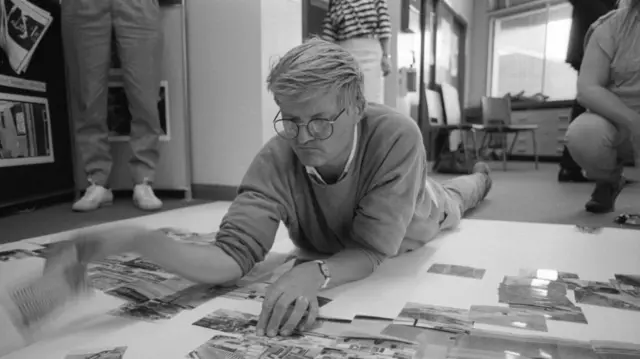 Image source,Board of Trustees of the Science Museum via Getty Images
David Hockney, who has died aged 88, used his life to craft a visual language that was unmistakably his own.
The Bradford-born man rose to become one of Britain’s favourite artists, and helped spearhead the 1960s pop art movement – using wartime Britain, California’s vibrant lifestyle, and iPad paintings to become a master across mediums. Our earlier post collates some of his most notable works.
He has been celebrated as a “true titan of British art” by Culture Secretary Lisa Nandy, and praised for his “vivid, instantly recognisable work” by Prime Minister Keir Starmer.
From Yorkshire to Europe to the Hollywood Hills, Hockney’s globetrotting meant his work reached far and wide. We set out some of the key milestones from across his life.
“I want my art to be joyful,” Hockney told our culture editor Katie Razzall in an interview last year.
His artistic legacy will continue, with the Tate Britain in London working closely with his team to finalise the two projects he was preparing to showcase next year.
We’re now ending our live coverage. You can head over here to read more on his life and legacy.
-

Even when frail, Hockney had an enthusiasm for lifepublished at 08:43
 Katie Razzall
Culture editor
I was fortunate to interview David Hockney three times.
On the first occasion, when I was a young journalist, he only wanted to talk about smoking (the smoking ban was coming in and he was vehemently opposed).
But twice we met and talked in depth about his art and life, most recently last year in Paris.
It had been touch and go whether he would make it to his biggest show ever. He was so delighted that his failing health had held up for the trip, and he told me it was also his best show ever.
He was frail but had lost none of his enthusiasm for life. The infectious laughter and wry wit was still evident.
He told me all he wanted to do was paint.
What other living artist could have filled the five floors of the Fondation Louis Vuitton – and been such a draw?
I will never forget how happy he was as the exhibition opened. A fitting tribute to a wonderful artist.
-
-
-
The Bradford boy who changed modern artpublished at 08:34
Grace Wood
BBC News, Yorkshire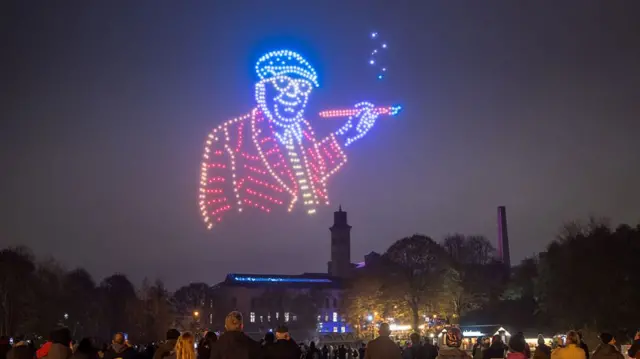 Image source,Getty Images
Image caption, A drone depiction of David Hockney adorns the sky above Salts Mill and Saltaire in Bradford
David Hockney had deep roots to the West Yorkshire city of Bradford.
Simon Hinchliffe, the principal of Bradford Grammar School, where Hockney studied from 1948 to 1953, says he was one of the school’s most influential alumni.
“We hold David’s contribution to the world of art and the way we see the world in high regard,” Hinchliffe says.
“He was an incredible figure, he will be deeply missed. His legacy will be lasting – of that I’m sure.”
Meanwhile, Mayor of West Yorkshire Tracy Brabin says “words alone don’t do David justice”.
“His work, those pioneering pieces that burst onto the scene with vivid colour, changed the trajectory of modern art,” she writes on X.
-
Sir James Dyson, a friend of Hockney’s, describes his ‘creative genius’published at 08:24
 Steven McIntosh
Entertainment reporter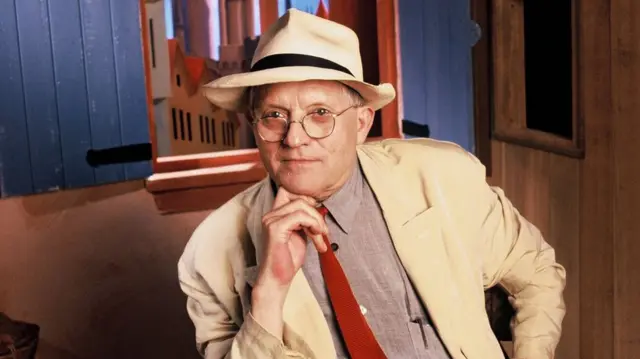 Image source,Getty Images
Image caption, David Hockney, pictured in 2001
Sir James Dyson remembers David Hockney as a “creative genius” who “experimented and experimented”.
“I was lucky to have been at the Royal College of Art shortly after him, following in the wake of his artistic energy,” Sir James says in a statement shared with BBC News.
“I will always recall his charming Yorkshire voice explaining in his unique and articulate way his approach to art.”
He adds: “I remember a lunch with him in Paris, where he revealed his iPad which had been hidden in a poacher’s pocket. He inspired every one of us with his bold realism, his perceptive colours, and his breathtaking iPad paintings.”
Hockney graduated from the Royal College of Art in 1962. Sir James graduated in 1969, and the pair later became friends.
-
-
-
Hockney leaves behind ‘powerful legacy’ – culture secretarypublished at 08:13
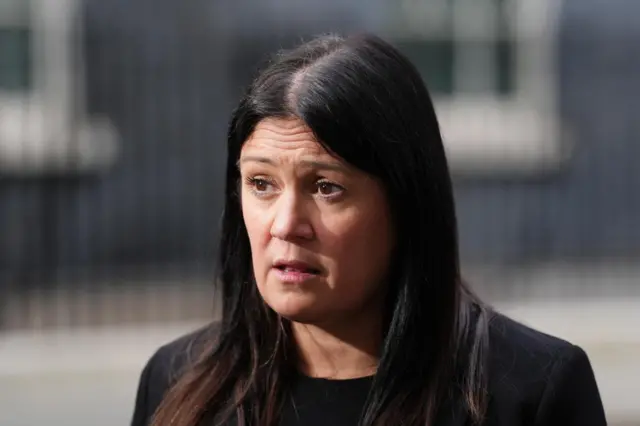 Image source,PA
Culture Secretary Lisa Nandy describes Hockney as a “true titan of British art” in a tribute posted on X.
She says his paintings “have inspired people across the world” ever since his first exhibition, ‘David Hockney: Pictures with People In’ in 1963.
Nandy adds: “His boundless creativity and restless spirit leave behind a powerful legacy.”
-
From Bradford to Los Angeles – Hockney’s art travelled farpublished at 08:05
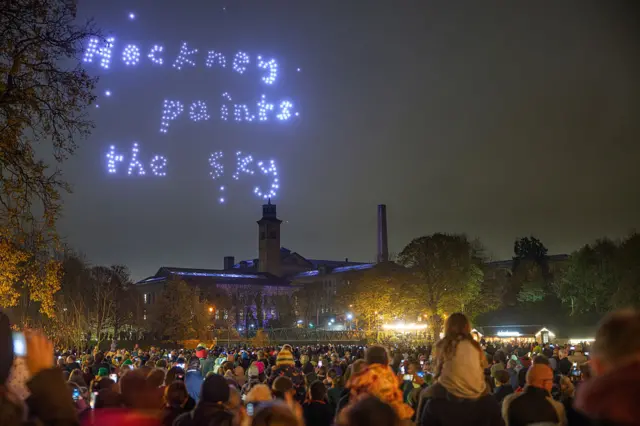 Image source,Getty Images
Image caption, More than 600 illuminated drones lit up the sky in Hockney’s hometown of Bradford in 2025
Hockney travelled the world with his art and ever-changing techniques and influences.
Here are some key dates from his life:
1937: Born in Bradford, West Yorkshire, later attending Bradford Art School.
1959: After two years of National Service – where as a conscientious objector, he worked as an orderly in hospitals – he joins the Royal College of Art.
1964: As his painting career takes off, Hockney moves to LA – in the years following he paints some of his most famous work – including ‘A Bigger Splash’.
1979: After years of working across Europe, he moves to the Hollywood Hills and turns his focus to portraits.
1988: He creates the first piece of art via fax machine.
2002: Hockney begins painting watercolours, later working “en plein air” [painting outside] in the East Yorkshire countryside.
2010: Hockney starts painting on an iPad.
2017: The artist celebrates his 80th birthday with exhibitions around the world, and creates 3D photographic drawings.
2025: ‘Hockney 25’ exhibits in Paris, with over 400 works spanning decades.
-
-
In pictures: Some of Hockney’s greatest workspublished at 07:59
Here are some of David Hockney’s most notable works from the past 60 years.
His paintings have depicted intimate portraits of friends, the colourful landscape of Californian life, and the natural beauty of Yorkshire.
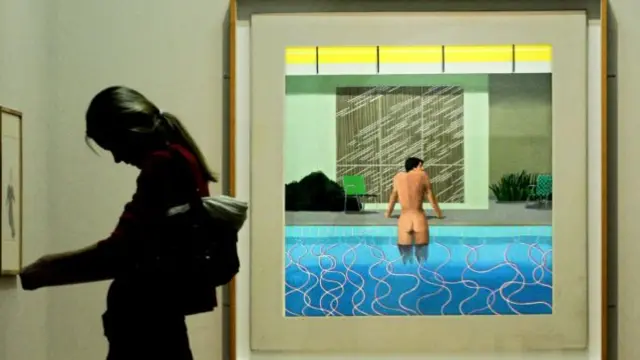 Image source,AFP via Getty Images
Image caption, In 1966, Hockney completed ‘Peter Getting Out of Nick’s Pool’, which is now held at the Walker Art Gallery in Liverpool
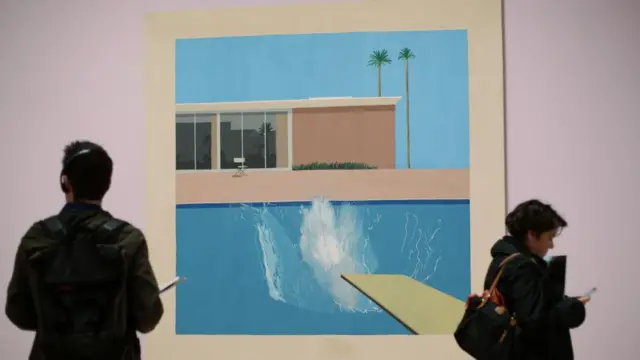 Image source,PA Wire
Image caption, Hockney painted ‘A Bigger Splash’ (1967) after being taken aback by California’s colourful and relaxed lifestyle
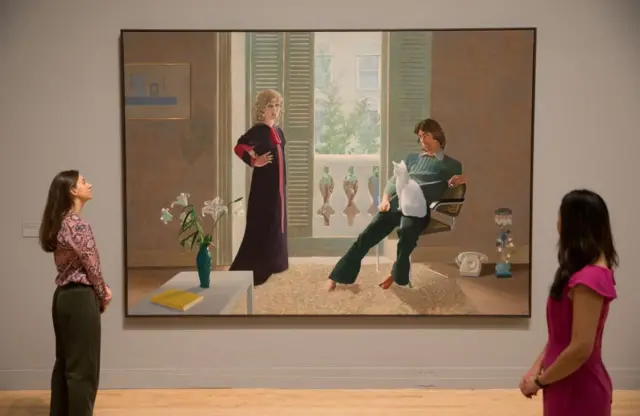 Image source,AFP via Getty Images
Image caption, ‘Mr and Mrs Clark and Percy’ (1970-1) depicts fashion designer Ossie Clark and the textile designer Celia Birtwell in their flat in Notting Hill Gate with their cat
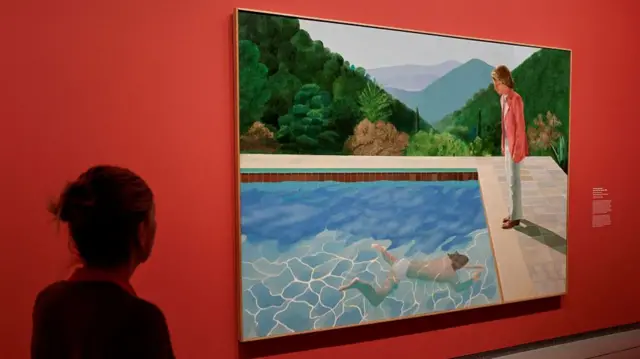 Image source,AFP via Getty Images
Image caption, ‘Portrait of an Artist (Pool with Two Figures)’ was completed in 1972, and captures a peaceful yet humanised snapshot
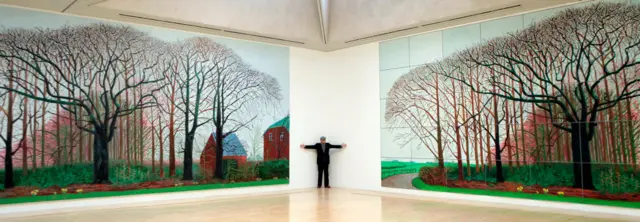 Image source,AFP via Getty Images
Image caption, Hockney stands next to his 2007 painting ‘Bigger Trees Near Warter’, the largest he ever created – it comprises 50 smaller canvasses of a landscape near the East Yorkshire village of Warter
-
Hockney embraced modern technology through his artpublished at 07:53
 Annabel Rackham
Culture reporter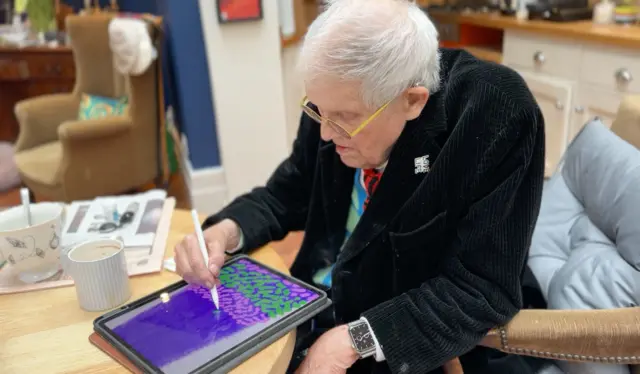 Image source,PA Media
Image caption, Hockney often created artworks on his iPad in later life
David Hockney was at the forefront of experimenting with using new technology to make art.
When faxes were at the cutting edge in the 1980s, he would send dozens of pages to be assembled into a giant artwork by the recipient.
As technology marched on, he used an iPad extensively, and a collection of his iPad drawings famously sold at auction for £6.2m in 2025.
The 17 prints, titled The ‘Arrival of Spring in Woldgate’, were started in 2011, when Hockney moved from the US to Bridlington.
He told the Royal Academy of Arts in 2021 that lockdown allowed him to experiment with this “new medium”.
-
Hockney taught us to celebrate the beauty of being alivepublished at 07:49
Katie Razzall
Culture editor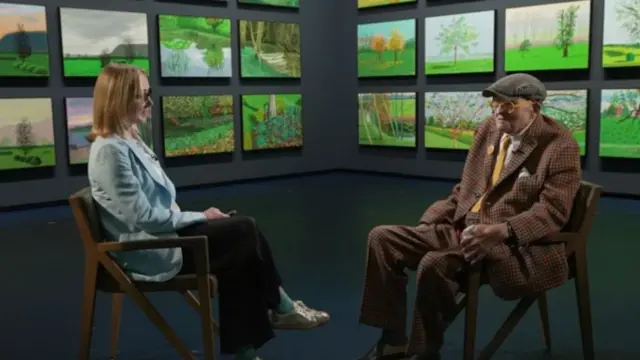
Image caption, Katie Razzall speaking to David Hockney
The world has lost some of its colour.
Because that’s what Britain’s best loved modern artist brought us.
He once told me “colour is a joyful thing. I want my art to be joyful.” And it is.
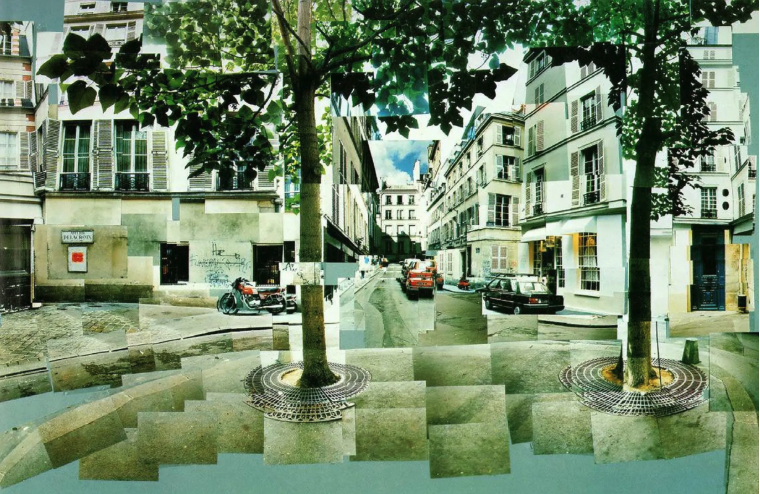
Whether his paintings of nature or swimming pools, his portraits of friends or his digital experiments, Hockney was an endless innovator – on canvas and iPad, through his photo collages.
But his essence was joy – and looking closely at things the rest of us miss.
He told me: “I can look at a puddle and get pleasure out of them. Most people think it’s just raining.”
He was the British artist everyone had heard of – and he was working to the end. Drawing and painting was “all I want to do now”.
Hockney taught us to celebrate the beauty of being alive – and his works live on.
-
PM pays tribute to Hockney’s ‘vivid, instantly recognisable work’published at 07:38
Following the death of David Hockney, Keir Starmer has described him as “one of Britain’s most celebrated artists”.
A No 10 spokeswoman says: “The Prime Minister is saddened to hear of the death of David Hockney, one of Britain’s most celebrated artists.
“His vivid, instantly recognisable work influenced generations of artists, and the Prime Minister’s thoughts are with his friends and family.”
-
Hockney remembered as ‘an absolute master’ in France, where he had a homepublished at 07:27
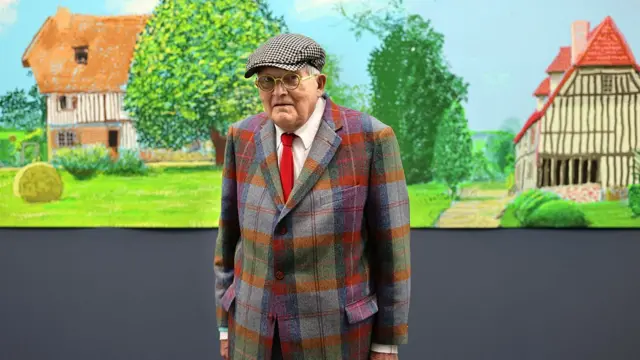 Image source,Getty Images
Image caption, Hockney created a 91-metre-long landscape of Normandy
More tributes are coming in, including from France, where David Hockney spent a considerable amount of time.
Eric Ciotti, the mayor of Nice, writes on X that “the art world has lost an absolute master”.
“Nice cherishes the memory of the exceptional bond he shared with Henri Matisse, his mentor.”
Meanwhile, an X account for the Normandy Region, where Hockney lived for a while, describes him as a “source of inspiration”.
Hockney painted the landscapes of his home in Normandy – a project completed during the Covid lockdown.
“His vision of our region will continue to enchant generations of visitors and admirers of his work,” the post on X says.
Hockney gave us revolutionary depictions of gay domestic lifepublished at 07:21
 Josh Parry
LGBT and identity reporterHockney’s depictions of homosexual life were nothing short of revolutionary.
In an otherwise conservative era, he broke social taboos by celebrating gay relationships through his art.
He often depicted the quiet, everyday moments of gay domestic life at a time when such scenes were just not seen in the mainstream.
And what made it so revolutionary? He started doing it at a time when being gay was still criminalised in the UK.
In 1961, as a second-year student at the Royal College of Art, six years before homosexuality began to be decriminalised, he painted ‘We Two Boys Together Clinging’, named after a Walt Whitman poem.
He later went on to describe his early works as “propaganda of something I felt hadn’t been propagandised as a subject: homosexuality.”
Dominic James Bilton, co-leader of the Queer British Art Network, told the BBC: “We’ve lost one of those people who were making changes in society before it was socially and culturally acceptable to be gay.
“He pioneered queer British art before it was fashionable to do so, before contemporary society built upon it.
“We’ve lost a giant of queer British art that subsequent generations have been inspired by and built upon and there’s not many people we can say that about.”
-
London mayor pays tribute to a ‘true icon and revolutionary of British art’published at 07:09
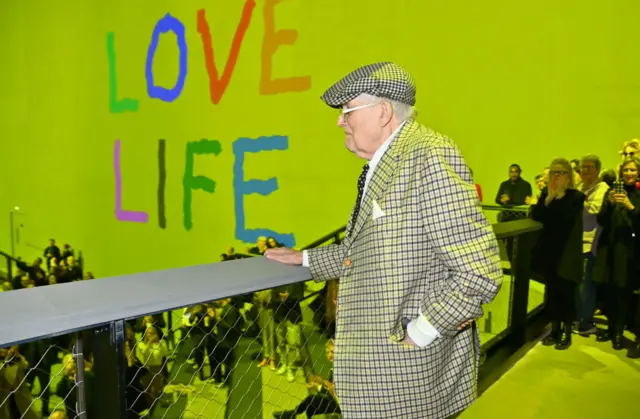 Image source,Getty Images
Image caption, David Hockney attends the gala opening of ‘Bigger & Closer’ in London in February 2023
Mayor of London Sadiq Khan describes Hockney as a “true icon”, and a “revolutionary of British art who never stopped reinventing his work”.
In a post on X, Khan highlights Hockney’s training at the Royal College of Art in London in the 1960s, and pays tribute to his “blockbuster London retrospectives”.
The mayor describes how Hockey’s “vivid paintings of our changing seasons” helped him to “see the beauty and fragility of our natural world”.
“I know his legacy will live on for centuries to come,” he adds.
-
Tate confirms it will go ahead with planned Hockney exhibitionspublished at 06:56
Steven McIntosh
Entertainment reporter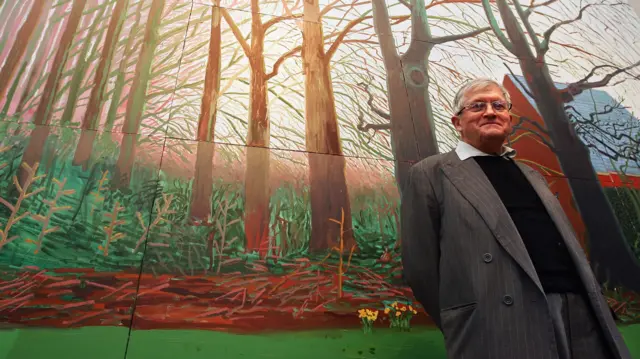 Image source,Getty Images
Image caption, Hockney pictured with one of his paintings at the Tate Britain in 2008
More tributes are coming in from the art world for David Hockney, with Tate Britain director Alex Farquharson saying the institution is “greatly saddened” by his death.
“David was an endlessly inventive artist, with a unique vision of the world,” Farquaharson says. “He was always completely and courageously himself, both in his work and in life.
“He taught us about the joy of looking, seeing things the rest of us failed to notice – his witty and sharp observations a constant presence within his work and in person.”
He adds: “The loss to the art world is immense: David’s passing brings to a close an extraordinary body of work characterised by reinvention. He touched so many, with his astonishing talent, his love for art and life, and his profound and unconventional insights.”
Farquharson confirms the Tate will be “working closely with David’s team to realise the two projects he was preparing for next year”.
They include a major exhibition at the Tate Britain, and a multimedia installation at the Tate Modern’s Turbine Hall.
-
‘British art has lost a giant’published at 06:49
Steven McIntosh
Entertainment reporter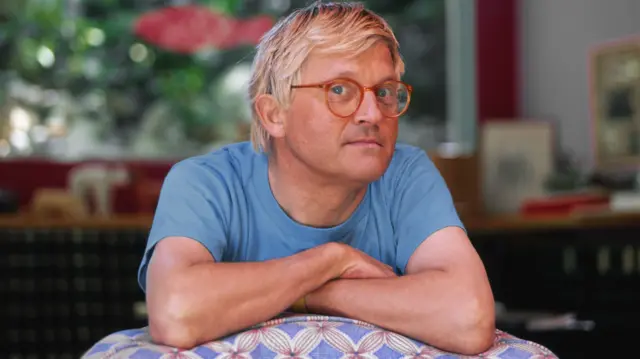 Image source,Getty Images
Image caption, Hockney pictured in his living room in Los Angeles in 1991
Paying tribute on social media, broadcaster Piers Morgan remembered Hockney as a “wonderful character” and recalled seeing him in London recently.
“One of Britain’s greatest ever artists, a Yorkshireman to his bootstraps, my neighbour in Kensington (often saw him on local manoeuvres, albeit in a wheelchair more recently) and a wonderful character.
He added: “Loved his quote: ‘Laugh a lot, it clears the lungs.’”
Labour MP Chris Bryant said he was “very sad” to hear Hockney had died.
“The recent exhibition in Paris was one of the most memorable I’ve seen in many years,” he added. “So innovative and inspiring.
“The way he renders shimmering water or night time scenes is amazing. And his line in portraits is perfect.”
Art historian Richard Morris said Hockney’s “huge achievement was to make serious painting look effortless”.
“He carried forward one of the most sustained investigations into vision, space and representation by any post-war artist,” Morris said.
“British art has lost a giant.”
In Los Angeles, Hockney found a luxurious new way of lifepublished at 06:39
Sam Woodhouse
BBC News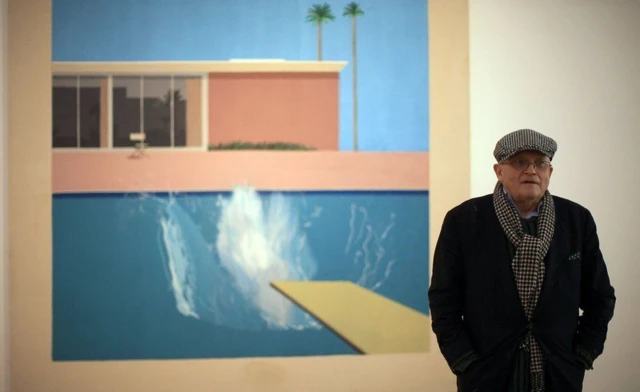 Image source,Getty Images
Image caption, Hockney’s ‘A Bigger Splash’ captures the moment an unseen diver creates chaos in paradise
In 1964, Hockney flew to Los Angeles – looking for the perfect light and bronzed torsos he’d seen in American male magazines.
Upon landing, he saw hundreds of swimming pools glittering in the valleys below him. They promised a carefree existence of affluence, leisure and sexual freedom.
Britain had only just abandoned rationing; in California, swimming pools weren’t luxuries – just a way of life.
Hockney was entranced. He ditched his British oil paints in favour of bright, Californian acrylics but retained his Bradford accent – which the Americans adored.
The swimming pools themselves – with glorious weather and naked male bodies – became Hockney’s most famous theme.
He had found his Paradise.
-
Hockney was still creating new works aged 87published at 06:33
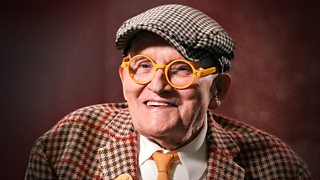
Media caption, David Hockney talks to Katie Razzall about his biggest-ever exhibition in Paris aged 87
After deciding to be an artist aged 11, Hockney became one of the most successful and influential artists of his generation, and was still creating new works at 87.
Happiest when making “joyful” art, and always innovating with his iPad, his works sold for millions.
Before his biggest-ever show opened in Paris last year, Hockney spoke to Katie Razzall about growing old, a recent visit from the King, and his two big loves – smoking and painting.
-
Hockney became famous for his figurative and experimental workpublished at 06:32
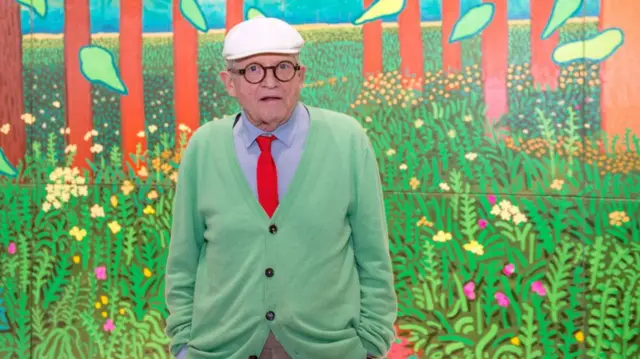 Image source,Getty Images
Image caption, David Hockney poses with one of his paintings in Paris in 2017
David Hockney, known for his figurative work, economy of line, and exploration of light and space, is considered one of Britain’s most influential contemporary artists.
Throughout a career spanning seven decades, Hockney experimented with painting, drawing, printmarking, watercolours and various other forms of art – including embracing technology by drawing on an iPad.
Hockney moved to Los Angeles in the 1960s, a move which inspired some of his most famous works, including swimming pool scenes such as ‘A Bigger Splash’.
In 2018, his work ‘Portrait of an Artist’ sold for $90m (£70m) at auction, setting a then-record for a living artist.
His work has been presented in art institutions around the world, including the Musuem of Contemporary Art in Tokyo, Tate Britain in London, and the Louis Vuitton Foundation in Paris.
-
Hockney’s career was one full of honourspublished at 06:22
Sam Woodhouse
BBC News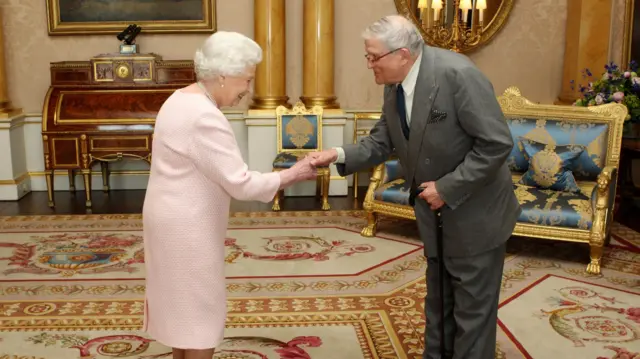 Image source,Getty Images
In a long career, David Hockney won every honour.
He turned down as many as he could.
In 1990, he refused a knighthood and was furious to discover he’d become a Companion of Honour.
The story goes that someone opened the letter and accepted on his behalf.
He did, however, accept the Order of Merit, the most prestigious award for high achievement. Believing it to be the personal gift of Queen Elizabeth II, Hockney felt it ungracious to decline.
But there was one tribute he did enjoy.
In 2007, a party was held at Tate Britain to celebrate Hockney’s 70th birthday. After dinner, it was announced that the smoke alarms would be turned off for 10 minutes to allow Britain’s Greatest Living Artist a cigarette.
It was the kind of honour plain ‘Mr’ Hockney did appreciate. And one which would not have been granted to anybody else.
-
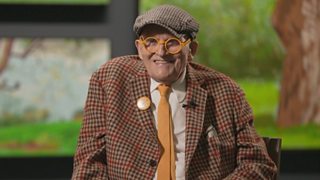
Hockney in pictures: An influential career spanning decadespublished at 06:19
From his contribution to the pop art movement in the 1960s, to painting a 91-metre work during the Covid pandemic, David Hockney was a majorly influential figure in the art world.
Here are some pictures from across the decades:
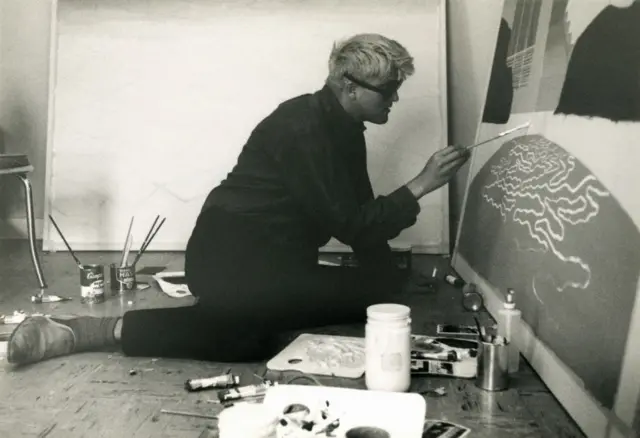 Image source,Getty Images
Image caption, Hockney painting in his home studio in Los Angeles in 1966
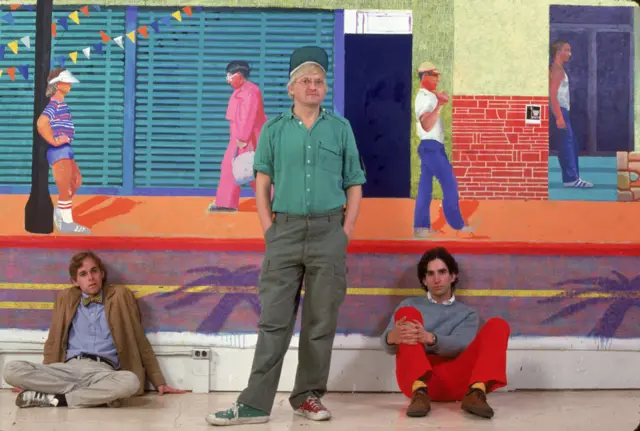 Image source,Getty Images
Image caption, Hockney pictured in front of his work, ‘Santa Monica Boulevard’, in 1980
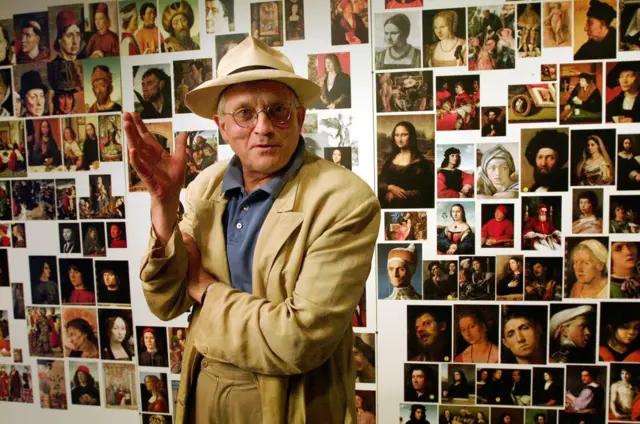 Image source,Getty Images
Image caption, Hockney’s “Great Wall” of portraits in his Los Angeles studio – pictured here in 2001
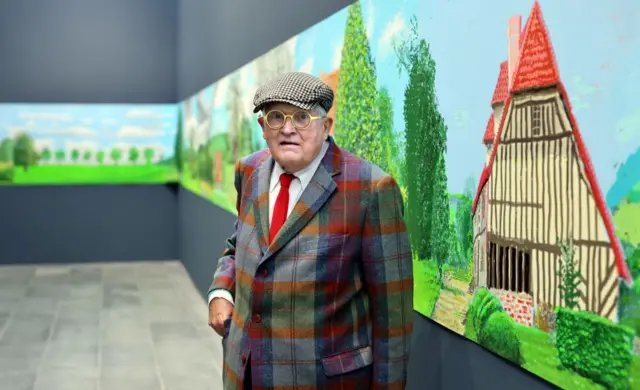 Image source,Getty Images
Image caption, Hockney in front of his painting ‘A year in Normandie’, a panoramic frieze painted during the Covid lockdown
-
-
Hockney was ‘star student’ at art school – but did things his own way published at 06:15
Sam Woodhouse
BBC News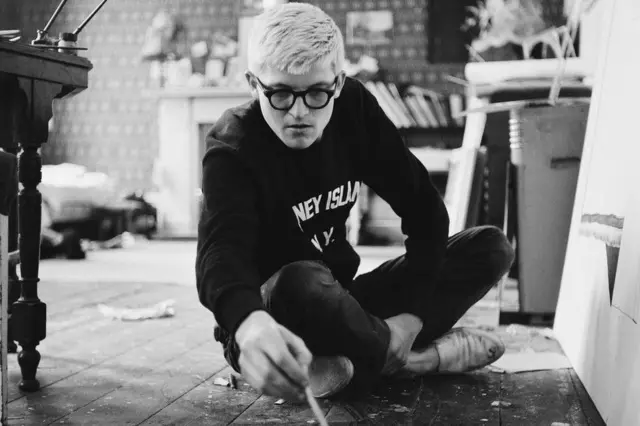 Image source,Getty Images
Image caption, Hockney, pictured at work in the 1960s, spent long hours in the studio and was often haunted by the feeling that he wasn’t getting enough done
Hockney studied at the Royal College of Art in London – but very much did things his own way.
His classmate, the American artist RB Kitaj, told him to ignore everyone else and simply paint things he loved. “It was the best advice I ever had,” he said.
What interested him was politics, literature and exploring his homosexuality. So one portrait showed himself in an act of love with the American poet, Walt Whitman.
Hockney was the college’s star student but still gloriously pig-headed. David refused to write the one essay required to graduate, and so failed his finals.
The resulting outcry forced the Royal College to back down. It gave him his degree and even awarded him its prestigious Gold Medal.
-
Hockney leaves behind a long-term partner and two brotherspublished at 06:13
David Hockney is survived by his partner Jean-Pierre Gonçalves de Lima.
He also leaves behind two brothers – Phillip and John – as well as a number of nieces, nephews, great-nieces and great-nephews.
Hockney’s publicist, Erica Bolton, specifically mentions his great-nephew Richard, who acted as his studio assistant towards the end of his life.
-
-
-
Hockney’s early art was influenced by growing up in wartime Britainpublished at 06:10
David Hockney was born on 9 July 1937.
His father, Kenneth, was a conscientious objector who detested social injustice, nuclear weapons and smoking in equal measure.
His mother, Laura, was the backbone of the family: strong-willed and devoutly Methodist.
David was one five children; during bombing raids, they hid under the stairs at their home in Bradford clutching bibles. In 1940, one explosion flattened the street.
The wartime shortage of paper restricted his early artistic efforts to drawing on the kitchen floor and hymn books in church.
-
Hockney’s legacy reflects his ‘enthusiasm for life’ – publicistpublished at 06:08
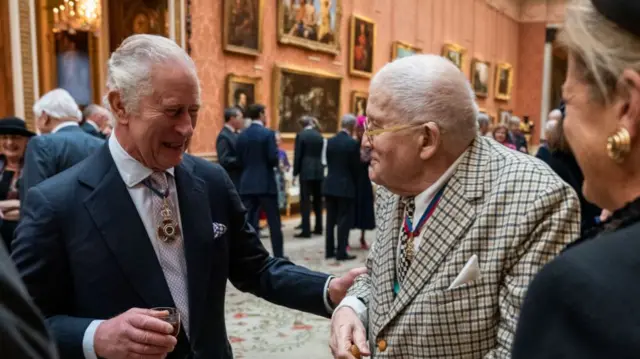 Image source,WPA Pool/Getty Images
We can now bring you some more from Hockney’s publicist, who describes how his “enduring legacy reflects his underlying enthusiasm for life”.
Erica Bolton notes some of the honours he received throughout his career, including being appointed by Queen Elizabeth II to the Order of the Companions of Honour in 1997 and to the Order of Merit in 2012.
She also mentions the periods of time he spent living in London and in Los Angeles – the scenes from which inspired a number of his works.
Bolton adds that Hockney is “considered one of the most influential and defining figures in contemporary art”.
-
-
-
David Hockney: ‘A genius in practically every medium’published at 06:01
Sam Woodhouse
BBC News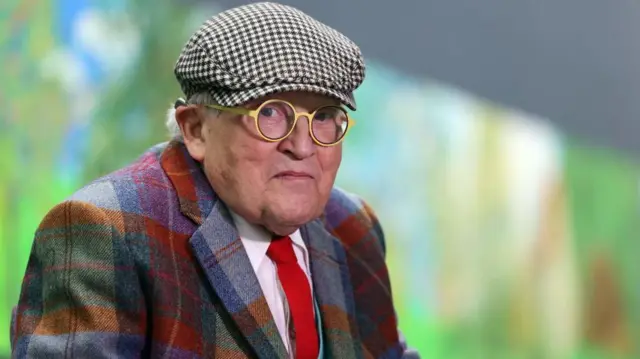 Image source,Getty Images
David Hockney, who has died aged 88, was Britain’s favourite artist – and a man of trenchant views, expressed in the broadest of Yorkshire vowels.
A genius in practically every medium, he worked with paint, photographs and iPads. He did etchings, lithographs, even stained glass windows – equally at home working with the grandeur of opera design and the intimacy of pen and ink.
A peroxide Bradford blond with round glasses and cheese-cutter hat, he set the art world alight in the 1960s, and packed out art galleries more than half a century later.
In 2018, one of his swimming pool paintings sold for nearly £70 million at auction – a record for a living artist. But Hockney was surprised at the public enthusiasm for his work.
He had simply followed one rule: “Paint the things you love”.
-
Hockney ‘passed away peacefully at home’ – publicistpublished at 05:56
We can now share this statement from David Hockney’s publicist, Erica Bolton:
“The celebrated British artist David Hockney, one of the most important figures in contemporary art in both the 20th and 21st centuries, passed away peacefully at home on 11 June 2026, one month short of his 89th birthday.”
-
-
David Hockney dies age 88published at 05:47
BreakingInfluential artist David Hockney has died at age 88, his publicist says.
This is a breaking story – we will bring you more shortly.
0 Comments